

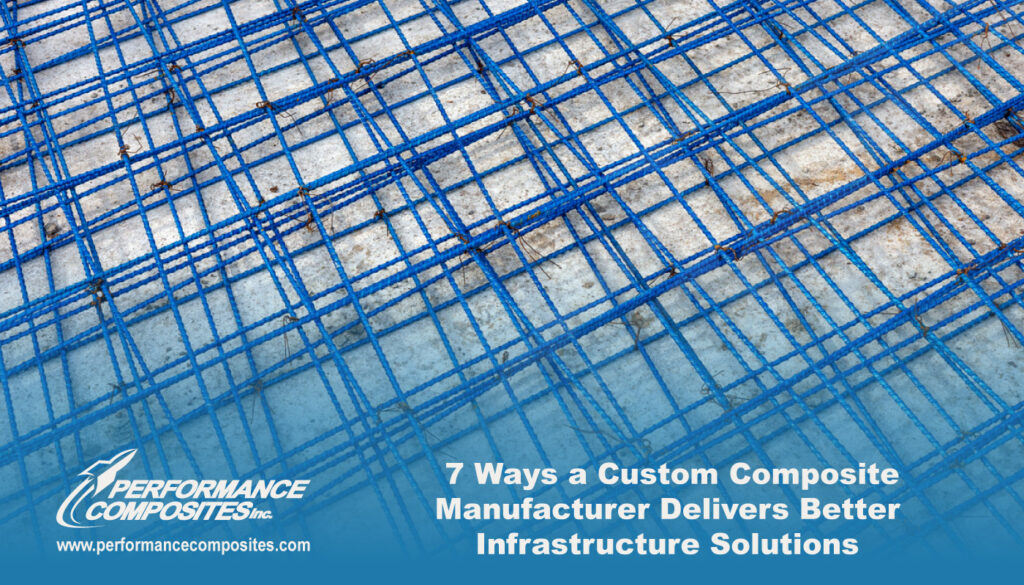
Infrastructure projects require components that can withstand structural loads, moisture, chemicals, temperature changes, and long-term environmental exposure. A manufacturer experienced with composite materials for infrastructure can design components around these demands instead of forcing a standard product into a specialized application.
Successful infrastructure composite manufacturing brings engineering, material selection, tooling, prototyping, inspection, and production into one coordinated process. This approach gives project teams greater control over part geometry, structural properties, repeatability, documentation, and delivery.
Deep Expertise in Composite Materials and Resin Systems
Composite performance depends on more than choosing a strong fiber. The reinforcement, resin system, core material, additives, fiber orientation, and manufacturing method must function together.
An experienced infrastructure composite manufacturer evaluates factors such as:
- Static, impact, and cyclic loads
- Moisture and salt exposure
- Acids, bases, and cleaning chemicals
- Operating temperatures
- Ultraviolet exposure
- Electrical conductivity requirements
- Flame and smoke specifications
- Surface and maintenance needs
This material knowledge helps prevent premature deterioration caused by choosing a system that does not match the service environment.
Precision Engineering Backed by Advanced Inspection
Infrastructure parts must fit existing structures, connect with other components, and transfer loads as intended. Dimensional errors can cause misaligned holes, uneven contact, installation delays, or unplanned field modifications.
Digital modeling, engineering analysis, 3D scanning, and coordinate measurement can help verify complex shapes and critical dimensions. Inspection requirements should be established during design so the manufacturer knows which features need to be measured and documented.
Advanced composite solutions combine engineering with practical manufacturing knowledge. A design must provide the required performance while remaining suitable for consistent production.
Custom Tooling Built for Project-Specific Requirements
Custom tooling gives manufacturers control over part shape, surface condition, repeatability, and integrated features. Molds can incorporate curves, ribs, mounting areas, openings, reference points, and other details required by the application.
Performance Composites maintains an in-house tooling department and manufactures its own tools. This capability connects tool development directly with engineering and production. When a prototype reveals an improvement opportunity, mold adjustments can be coordinated without relying entirely on a separate tooling company.
Owning the tooling process also supports:
- Closer dimensional control
- Faster design revisions
- Repeatable part production
- Improved communication between departments
- Better planning for future production volume
Prototyping and Modeling Before Full-Scale Production
Prototyping allows project teams to evaluate a component before committing to a complete production run. Depending on the application, the prototype may be reviewed for dimensions, fit, weight, assembly, structural behavior, surface quality, or manufacturing efficiency.
A structured development process can include:
- Defining application requirements
- Creating a digital model
- Reviewing materials and manufacturing methods
- Developing project-specific tooling
- Producing an initial component
- Inspecting and testing critical characteristics
- Refining the design before production
Finding a problem during prototyping is generally easier to manage than discovering it after numerous components have reached the installation site.
Scalable Manufacturing From Design Through Production
A capable manufacturer plans for production volume during the development stage. Tooling, material handling, labor, inspection frequency, and cycle times should support both immediate requirements and potential future demand.
Infrastructure composite manufacturing must remain consistent as output increases. Documented work instructions, controlled processes, stable tooling, trained personnel, and established acceptance criteria help protect quality between production runs.
Scalability also involves capacity planning. The manufacturer should understand anticipated order quantities, delivery schedules, and whether additional tools or production resources will be needed.
Material Selection Matched to Environmental Exposure
Infrastructure components can encounter significantly different conditions depending on where they are installed. A part used near saltwater may require a different material system than one exposed to wastewater chemicals, intense sunlight, heat, or electrical equipment.
The manufacturer should receive accurate information about:
- Chemical type and concentration
- Exposure duration
- Minimum and maximum temperatures
- Indoor or outdoor installation
- Expected loads
- Cleaning procedures
- Required service life
- Applicable performance standards
Composite materials for infrastructure must be evaluated as complete systems. A general statement that a composite is resistant to corrosion is not enough to confirm that it will perform in a particular chemical or thermal environment.
Long-Term Reliability That Reduces Lifecycle Maintenance Costs
Composite components do not rust like ferrous metals and may require fewer corrosion-control treatments in certain environments. Their lower weight can also simplify transportation, handling, installation, and future access.
Potential lifecycle advantages include:
- Fewer protective coating applications
- Reduced corrosion-related repairs
- Less frequent component replacement
- Lower handling and installation demands
- Reduced operational interruptions
- Longer intervals between major maintenance activities
These benefits depend on correct engineering, manufacturing, installation, and inspection. Composites are not maintenance-free, but properly designed components can reduce recurring work associated with corrosion-prone materials.
Frequently Asked Questions
What does a custom composite manufacturer provide beyond standard parts?
A custom manufacturer develops components around project-specific dimensions, loads, environmental conditions, and connection requirements. Services can include engineering support, material selection, custom tooling, prototyping, inspection, documentation, and production. This approach is useful when an available standard component cannot satisfy the application.
Why does in-house tooling matter for infrastructure projects?
In-house tooling allows engineering, mold development, and production teams to work within the same organization. This can simplify communication, support design revisions, and improve control over critical dimensions. Performance Composites builds its own tools to support coordinated development from the initial design through repeat manufacturing.
Can an infrastructure composite manufacturer replace a metal component with composite?
A metal part may be redesigned in composite, but direct material substitution is not always appropriate. Composite behavior depends on geometry, fiber orientation, connections, loads, and environmental exposure. The component should be engineered for the selected composite system instead of merely copying the dimensions of the original metal part.
How are custom composite components inspected?
Inspection methods depend on the part, process, tolerance, and application. Manufacturers may use visual inspection, templates, gauges, coordinate measurement, 3D scanning, or other testing methods. Critical dimensions and acceptance criteria should be defined before production so inspection results can be documented consistently.
Do custom composites reduce total infrastructure costs?
They can reduce lifecycle costs when corrosion resistance, lower weight, part consolidation, or reduced coating requirements limit future maintenance. However, value should be evaluated across design, tooling, production, installation, service life, and upkeep. The lowest initial part price does not always produce the lowest total project cost.
Summary
A custom composite manufacturer improves infrastructure solutions through material expertise, precision engineering, in-house tooling, prototyping, scalable production, environmental analysis, and lifecycle planning. Performance Composites brings these capabilities together to develop advanced composite solutions that meet project-specific structural, dimensional, and operating requirements.
Partner with Performance Composite for the Best Infrastructure Composite Manufacturing
Reach out today for a free consultation to discuss how our tailored composite solutions can enhance efficiency and elevate innovation in the infrastructure industry. Contact us – 310-328-6661.