

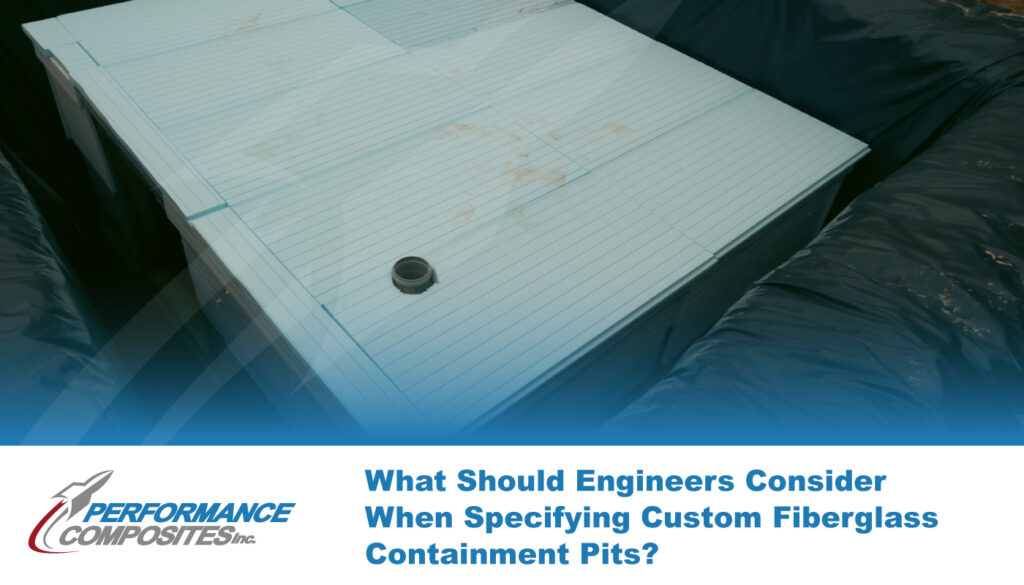
Custom fiberglass containment pits must be designed around what they will contain, where they will be installed, and the loads they may encounter throughout service. Chemical exposure, external pressure, surface loading, dimensions, wall construction, reinforcement, and installation constraints can all influence the final design.
Selecting composite materials for infrastructure containment applications therefore requires more than choosing fiberglass as a general material category. Engineers need to consider the resin system, reinforcement, geometry, structural requirements, environmental conditions, and manufacturing method together to develop a pit suited to its specific operating conditions.
Chemical Resistance: Matching Resin to the Contained Substance
Chemical exposure is one of the first considerations when specifying a containment pit. Different resin systems offer different resistance characteristics, so selection should reflect the substances the pit may contact and the expected concentration, temperature, and duration of exposure.
Engineers should establish these conditions before finalizing the material system. This information helps determine whether a proposed resin and reinforcement combination is appropriate for the intended environment.
Structural Loads: External Hydrostatic Pressure and Surface Loading
Containment pits may encounter forces from outside as well as inside the structure. Groundwater can create external hydrostatic pressure, while soil conditions, installation depth, equipment, traffic, or other surface activity may contribute additional loads.
Infrastructure composite manufacturing should account for the loads identified for the specific installation. Structural requirements can influence reinforcement, laminate construction, wall thickness, geometry, and other design decisions.
Eliminating Joints and Seams Through Custom One-Piece Shapes
Custom fabrication can allow a containment pit to be manufactured as a one-piece structure rather than assembled from multiple sections. Reducing joints and seams can simplify the finished configuration and eliminate connection points that would otherwise require additional design and fabrication considerations.
One-piece geometry can also be developed around the dimensions and layout required by the project, giving engineers greater flexibility when standard shapes do not match the installation.
Wall Thickness and Reinforcement for Long-Term Durability
Wall thickness should be determined by the loads, dimensions, material system, reinforcement, and service conditions of the individual pit. Simply increasing thickness without considering the complete laminate design does not provide a complete engineering solution.
Advanced composite solutions can use fiber orientation, reinforcement type, resin selection, and laminate construction together to achieve the required strength and stiffness. These variables should be evaluated as part of the complete structural design.
Sizing and Geometry for Site-Specific Installation Constraints
Infrastructure sites can impose strict dimensional limitations. Available excavation space, surrounding structures, equipment locations, access points, piping, and connection requirements can influence the size and geometry of a containment pit.
Using composite materials for infrastructure allows components to be designed around application-specific dimensions and configurations. Establishing site constraints early can reduce the likelihood that installation requirements conflict with a design after tooling or fabrication has begun.
Fiber and Resin Selection: Strength, Stiffness, and Cost Tradeoffs
Fibers and resins perform different functions within a composite structure. Reinforcement contributes to structural performance, while the resin binds the reinforcement and plays an important role in environmental and chemical resistance.
Choosing infrastructure grade composite materials requires balancing the performance requirements of the application with manufacturability and project cost. Engineers should consider strength, stiffness, chemical exposure, service environment, geometry, and expected loads rather than evaluating any one material property independently.
Working with an Engineering Team Early in the Design Process
Early engineering involvement allows material, structural, manufacturing, and installation requirements to be considered together. Potential challenges involving geometry, tooling, reinforcement, loads, or site access can be identified while design changes remain practical.
For infrastructure composite manufacturing, collaboration between engineering and manufacturing teams can also help ensure that a technically suitable design can be produced efficiently and consistently.
Prototyping and Material Selection Before Full Production
When a containment design will be produced repeatedly, prototyping can provide an opportunity to evaluate geometry, fit, manufacturing requirements, and other project-specific details before full production begins.
Material selection should also be established before production tooling and processes are finalized. Testing, engineering analysis, prototypes, or other validation methods may be appropriate depending on the requirements and criticality of the application.
This development stage helps connect composite materials for infrastructure with the manufacturing process that will ultimately be used to produce the finished containment pits.
Frequently Asked Questions
Why is resin selection important for a fiberglass containment pit?
The resin system contributes significantly to a fiberglass structure’s resistance to chemicals and environmental exposure. Engineers should consider the substance being contained, its concentration, operating temperature, expected exposure duration, and other service conditions before selecting an appropriate resin system.
What structural loads should be considered when designing a containment pit?
Loads vary according to the installation but may involve external hydrostatic pressure, surrounding soil, installation depth, equipment, and surface loading. Identifying expected conditions allows engineers to determine appropriate wall construction, reinforcement, geometry, and other structural requirements.
Can fiberglass containment pits be manufactured as one-piece structures?
Custom composite fabrication can make one-piece containment structures possible for suitable designs and manufacturing processes. A one-piece configuration reduces the number of joints and seams and can allow the pit geometry to be tailored to project-specific dimensions and installation requirements.
How is the correct wall thickness determined for a fiberglass containment pit?
Wall thickness should be engineered according to the pit’s dimensions, loads, reinforcement, laminate construction, material system, and operating environment. It should be considered as one part of the complete structural design rather than selected as an isolated specification.
Why should engineers involve a composite manufacturer early in the project?
Early collaboration allows engineering requirements to be considered alongside material selection, tooling, manufacturability, site restrictions, and potential production quantities. This can help identify design or fabrication challenges before tooling is completed and creates a clearer transition from engineering into production.
Summary
Custom fiberglass containment pits should be engineered around the chemical, structural, environmental, and installation conditions of the individual project. Resin and fiber selection, wall construction, reinforcement, geometry, external loads, and manufacturing requirements all contribute to the finished design. Connecting these considerations early helps infrastructure composite manufacturing move from an application-specific concept toward a practical, manufacturable containment solution.
Build the Right Solution from the Ground Up
Bring your application requirements, site constraints, performance goals, and production needs to an experienced composite engineering and manufacturing team. Start the conversation about a custom fiberglass containment solution designed around the demands of your project. Contact us at 310-328-6661.